
The Science of Touch:
Evidence-Based Insights into Abhyanga (Ayurvedic Massage) for Well-being
PART 2
This is a continuation of Part 1 of the evidence-based insights. I have chosen two additional publications that further support the science behind touch and Ayurvedic Massage (Abhyanga). The first article discusses how Ayurveda, particularly Abhyanga, along with Physiotherapy, can help manage common sports injuries. The second article explores the potential for incorporating Ayurvedic massage (Abhyanga) into post-stroke rehabilitation.
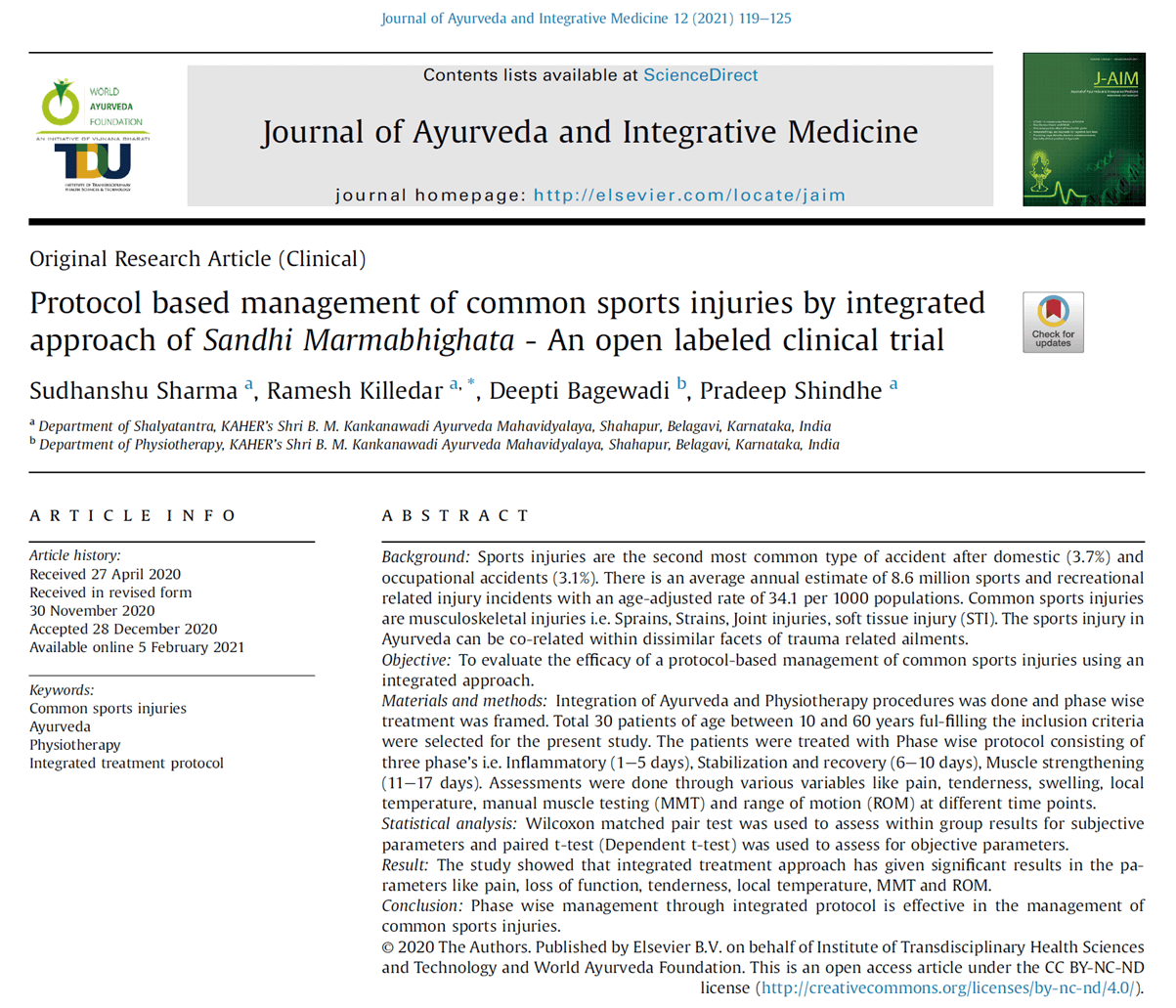
Sharma, S., Killedar, R., Bagewadi, D., & Shindhe, P. (2021). Protocol based management of common sports injuries by integrated approach of Sandhi Marmabhighata - An open labeled clinical trial. Journal of Ayurveda and Integrative Medicine, 12(1), 119–125. https://doi.org/10.1016/j.jaim.2020.12.009
This clinical trial investigated an integrated approach combining Ayurveda and Physiotherapy for the management of common sports injuries, correlating them with Ayurvedic concepts like Sandhi Marmabhighata (soft tissue/joint trauma) and Vatadidosha. The study involved 30 patients aged 10-60 years with sports injuries (like ankle, knee, wrist, elbow, shoulder) over a 17-day treatment protocol structured in three phases (inflammatory, stabilization/recovery, muscle strengthening/ROM restoration). Ayurvedic therapies used included topical applications (like Manjishtadi lepa, Murrivenna taila pichu, Sthanika Abhyanga), internal medications (Marma gulika, Bhadarakadi Ghrita, Balaarishta), and fomentation (Shastika shali pinda sweda). The results showed significant improvement in parameters such as pain, tenderness, swelling, range of motion (ROM), and manual muscle testing (MMT), leading to the conclusion that this integrated protocol is effective for common sports injuries.
Key Takeaway :
Integrated Approach: The study highlights the effectiveness of combining Ayurveda and Physiotherapy for sports injury management.
Ayurvedic Correlation: Sports injuries are correlated with Ayurvedic concepts of Sandhi Marmabhighata (soft tissue/joint trauma) and Vatadidosha (imbalanced Vata).
Structured Protocol: A 17-day, phase-wise treatment protocol was implemented, addressing inflammation, tissue repair, and muscle strengthening.
Role of Abhyanga: Sthanika Abhyanga (localized Ayurvedic massage) with Murrivenna taila was a key Ayurvedic therapy in the intermediate and advanced rehabilitation phases, supporting muscle function and joint mobility.
Positive Outcomes: The integrated treatment led to significant improvement in objective parameters like pain reduction, swelling, tenderness, and enhanced range of motion (ROM) across various joints (ankle, knee, wrist, elbow, shoulder).
Comprehensive Therapies: Other Ayurvedic interventions included Manjishtadi lepa (medicated paste), Bhadarakadi Ghrita (medicated ghee), Marma gulika, Balaarishta, and Shastika shali pinda sweda (bolus fomentation).
Rehabilitation Focus: The approach contributes to rehabilitation by supporting tissue regeneration, muscle performance, and pain management.
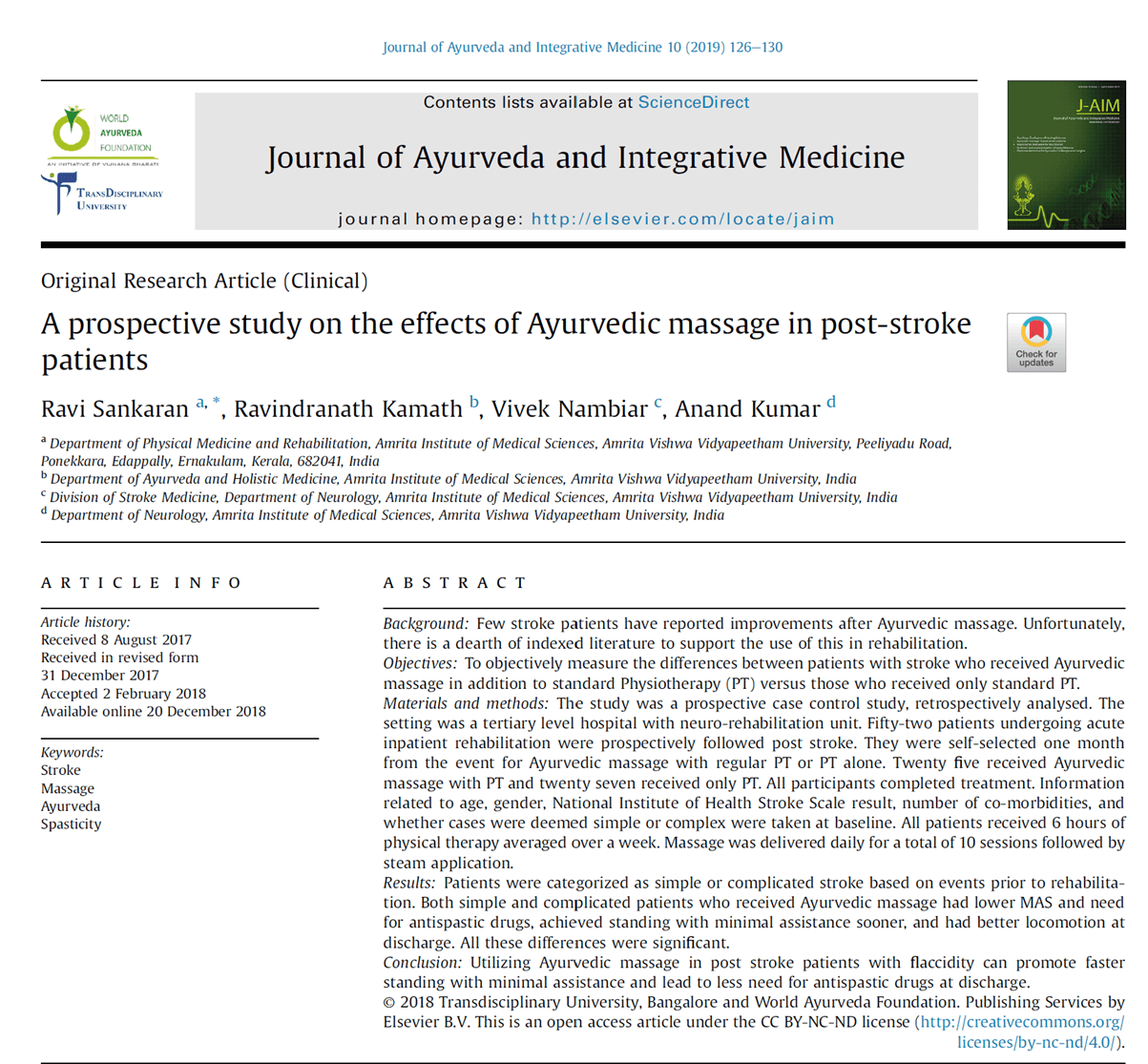
Sankaran, R., Kamath, R., Nambiar, V., & Kumar, A. (2019). A prospective study on the effects of Ayurvedic massage in post-stroke patients. Journal of Ayurveda and Integrative Medicine, 10(2), 126–130. https://doi.org/10.1016/j.jaim.2018.02.137
Summary: This research indicates that integrating Ayurvedic massage (Abhyanga) into post-stroke rehabilitation leads to demonstrably better patient outcomes.
Key Takeaways:
Patients who received Ayurvedic massage along with conventional physical therapy achieved standing independence earlier.
They experienced a significant reduction in spasticity (measured by MAS) and a lower reliance on antispastic drugs.
Locomotion improved more effectively by discharge in the massage group.
The intervention was well-tolerated by patients.
Please take note: This study had its own limitations but nevertheless there is a possible prospect of Abhyanga providing better patient outcomes in post-stroke rehab.
Disclaimer:
The information presented in this resource, including summaries and references to scientific publications, is intended solely for educational and informational purposes. While this content aims to highlight existing research and insights into Abhyanga (Ayurvedic massage), it is not intended to provide or replace professional medical advice, diagnosis, or treatment. The scientific understanding of ancient practices, including Ayurveda, is continually evolving, and individual responses may vary.
It is essential to consult with a qualified healthcare provider or medical professional regarding any health concerns, medical conditions, or before making any health-related decisions, lifestyle changes, or engaging in any therapeutic practices mentioned. The discussion of benefits and mechanisms of Abhyanga herein is based on available literature and traditional Ayurvedic principles, and should not be interpreted as a guarantee of specific results or a claim to cure, prevent, or treat any medical condition.
Curious to experience the evidence-backed support of Abhyanga for yourself? At REVIVE Ayurveda, our personalised Ayurvedic massage services are designed to promote relaxation, balance, and overall well-being. Learn more about how Abhyanga may complement your health journey or book a free 20-minute consultation to discuss your unique needs.